For commercial enterprises, manufacturing exporters, educational institutions, real estate builders, and healthcare networks across Jaipur and Rajasthan, marketing brochures remain the backbone of face-to-face commercial transactions. Whether distributed at property site visits, medical conferences, institutional admissions, or retail dealerships, a well-engineered brochure delivers tangible brand credibility.
However, purchasing procurement managers frequently ask: How do we reduce the unit cost of bulk brochure printing in Jaipur without compromising paper crispness, photographic sharpness, or brand integrity? The answer lies not in choosing the lowest unverified bidder, but in understanding commercial offset manufacturing mechanics, sheet imposition efficiency, paper mill grades, and transparent specification comparisons.
1. The Economics of Bulk Offset Printing: Fixed Setup Costs vs. Variable Sheet Costs
To understand why bulk printing dramatically lowers unit costs, one must examine the cost structure of a commercial multi-color offset printing press. Unlike digital toner copiers, setting up an industrial sheetfed offset press involves significant fixed upfront preparation:
- Thermal CTP Plate Imaging: Four separate anodized aluminum plates (Cyan, Magenta, Yellow, Key Black) must be laser-imaged at 2400 DPI. For an 8-page or two-sided work-and-turn sheet, this requires multiple plates regardless of whether 100 or 10,000 brochures are printed.
- Press Make-Ready & Ink Inking: Machine operators must mount plates, calibrate register pins, balance ink-fountain keys across ink zones, and achieve correct ink density.
- Make-Ready Paper Waste: Between 50 and 150 parent sheets are consumed purely during ink-water balance setup and color registration before the first saleable sheet is produced.
Because these setup costs are fixed (e.g., approximately ₹2,500 to ₹4,500 depending on plate size and machine configuration), printing only 200 copies means that fixed setup alone adds over ₹15–₹20 per brochure. However, when printing 5,000 or 10,000 copies, that same fixed setup drops to pennies per unit (₹0.25 to ₹0.45 per piece), leaving paper stock and ink as the primary marginal expenses.
2. Core Cost Drivers: Paper Weight, Formats, and Surface Finishes
Smart commercial buyers control their printing expenditure by adjusting five specific technical levers:
- Paper Grammage (GSM): Coated art paper ranges from 130 GSM up to 350 GSM. Selecting a 170 GSM art paper instead of a 300 GSM art card can reduce raw paper expenditures by 25% to 35% while still providing adequate opacity and a professional tactile hand-feel.
- Sheet Optimization & Trim Wastage: Standard commercial parent paper sheets in India measure 23x36 inches, 20x30 inches, or 25x36 inches. Choosing non-standard trim sizes (e.g., an arbitrary 9.2 x 12.5 inches) creates excessive unprinted trim scrap, inflating raw material costs. Standard A4 (8.27 x 11.69 inches) or A5 formats nest perfectly onto standard parent sheets with negligible waste.
- Post-Press Surface Enhancements: Thermal BOPP matte or gloss lamination adds durability and scuff resistance, but increases unit cost. For high-volume mass-distribution brochures, opting for an inline water-based aqueous coating (varnish) provides ink protection at a fraction of the cost of film lamination.
- Folding Geometry: A standard single-crease bi-fold or two-crease tri-fold (roll fold or Z-fold) is executed rapidly on automated high-speed folding machines. Complex multi-gate folds or accordion folds with die-cut tabs require specialized setup and manual interventions that increase labor charges.
3. Digital Short-Run vs. Offset Bulk: When Does Unit Cost Plummet?
Commercial printers use both digital dry-toner/liquid-ink presses and industrial offset presses. Knowing when to transition from digital to offset is the key to minimizing procurement spend:
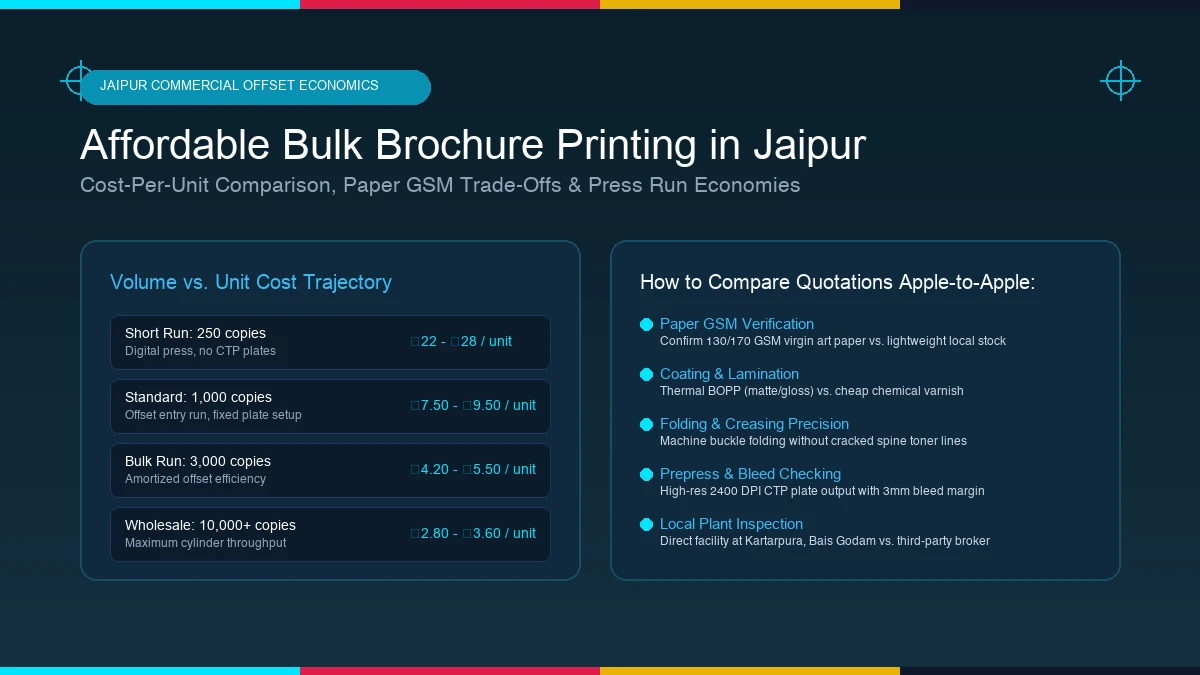
- Short-Run Digital (50 to 400 Copies): Digital printing requires zero plates and near-zero setup waste. For quick mockups, small conferences, or localized tests, digital is faster and cheaper on total invoice value. However, the cost per unit remains relatively flat (e.g., ₹18 to ₹30 per unit).
- The Crossover Threshold (500 to 1,000 Copies): At approximately 500 to 1,000 copies of an A4 4-page bi-fold brochure, commercial offset printing surpasses digital efficiency.
- The Bulk Offset Zone (2,500 to 10,000+ Copies): Above 2,500 copies, offset press speed (often 8,000 to 12,000 impressions per hour) drops unit costs dramatically, frequently achieving pricing below ₹3 to ₹6 per multi-color unit depending on paper weight.
4. How Pre-Press Accuracy Prevents Expensive Reruns and Revision Surcharges
Submitting improper artwork files to a commercial printer frequently generates hidden costs and unexpected project delays. The most common pre-press traps include:
- RGB to CMYK Color Shifts: Artwork designed for digital screens uses additive RGB color. When RIP software converts RGB files to CMYK inks without press profiling, vibrant blues turn dull purple and bright greens lose saturation.
- Missing 3mm Bleed Allowances: Background photos or color blocks ending precisely on the trim line result in unsightly white hair-lines if automated guillotine blades shift by even 0.5mm. Adding a 3mm bleed completely eliminates this risk.
- Unflattened Transparencies & Non-Outlined Fonts: Complex drop shadows and missing system fonts can corrupt during plate imaging. Submitting PDF/X-1a files with all typographic fonts converted to outlines (vector curves) guarantees typographic integrity.
5. The "Cheapest Quote" Fallacy: Hidden Quality Traps in Commercial Printing
When comparing quotations from commercial printers in Jaipur, receiving an estimate that is 30% lower than the market average is almost never a stroke of good fortune. Unusually cheap quotes typically hide significant compromises:
Common Hidden Compromises in Cut-Rate Print Quotes:
- Sub-Mill Paper Substitution: Substituting unbranded or secondary-lot paper that exhibits inconsistent thickness, poor opacity, and yellowing edges instead of certified Grade-A mill stock (e.g., ITC, Bilt, or Century).
- Reduced Ink Density: Dialing down ink keys to conserve expensive cyan and magenta pigments, leading to washed-out photographs and weak contrast.
- Manual Hand Folding vs. Machine Creasing: Hand-folding heavy cardstock (250+ GSM) without prior mechanical creasing, causing cracked paper fibers and peeling ink along the spine fold.
- Wet Lamination Instead of Thermal BOPP: Using low-cost solvent-based wet film that bubbles, delaminates in Jaipur's summer heat, and emits volatile chemical odors.
- Unpackaged Bundles: Tying brochures with abrasive plastic twine that cuts into paper edges rather than shrink-wrapping packs in protective 5-ply corrugated cartons.
6. Illustrative Bulk Brochure Cost and Specification Comparison Table
To understand how volume, paper weight, and finishing affect total spend and unit costs, review this illustrative comparison for a standard 4-Page A4 Bi-Fold Brochure (Finished Size: 8.27 x 11.69 inches, Open Size: 16.54 x 11.69 inches, 4-Color CMYK both sides):
| Print Run (Units) | Paper Specification | Surface Finishing | Fixed Pre-Press & Plates | Illustrative Unit Cost | Cost Trend Rationale |
|---|---|---|---|---|---|
| 500 copies | 170 GSM Coated Art | Aqueous Varnish / None | Amortized over 500 units | ₹9.00 – ₹13.00 / pc | High unit cost due to fixed plate & setup burden |
| 1,000 copies | 170 GSM Coated Art | Thermal Matte Lamination | Amortized over 1,000 units | ₹6.50 – ₹8.50 / pc | Offset efficiency emerges; plate cost drops per unit |
| 2,500 copies | 210 GSM Art Card | Thermal Matte + Crease | Amortized over 2,500 units | ₹4.80 – ₹6.20 / pc | Optimal commercial B2B volume pricing tier |
| 5,000 copies | 170 GSM Coated Art | Machine Fold + Varnish | Amortized over 5,000 units | ₹3.20 – ₹4.50 / pc | High-volume distribution tier; paper mill cost dominates |
| 10,000 copies | 170 GSM Coated Art | Machine Fold + Varnish | Amortized over 10,000 units | ₹2.50 – ₹3.50 / pc | Wholesale production tier with maximum economies of scale |
*Disclaimer: The above figures are illustrative estimates for educational and commercial planning purposes only. Actual quotations vary based on current paper mill pulp prices, exact sheet sizes, spot finishes, and prevailing raw material rates.
7. Evaluating Local Jaipur Printing Hubs: What to Look For
Jaipur serves as the primary commercial, industrial, and publication printing capital for Rajasthan. When evaluating commercial printing facilities across Jaipur's key manufacturing zones, commercial buyers should visit or verify the physical manufacturing capabilities of the supplier:
- Kartarpura & Bais Godam Industrial Belt: Centrally positioned in Jaipur with direct logistics access to corporate offices in C-Scheme, MI Road, Tonk Road, and Mansarovar. Renowned for fast-turnaround commercial printing, packaging development, and accessible press-pass inspections.
- Sitapura Industrial Area: Home to heavy industrial manufacturing, apparel export houses, and large-format commercial printing plants capable of high-volume runs for government and export clients.
- Vishwakarma Industrial Area (VKI Area): Situated in northern Jaipur, providing specialized corrugated packaging, high-volume publication web printing, and regional distribution toward Sikar and Haryana.
What to Inspect at the Printing Press: Before awarding large annual contracts, request a 15-minute facility visit. Check whether the printer operates multi-color sheetfed offset presses (such as 4-color or 5-color Heidelberg, Komori, or Mitsubishi presses), an in-house thermal CTP imaging system, automated programmable paper cutters (guillotines), and dedicated mechanical folding/creasing units. Facilities with integrated post-press finishing offer significantly tighter quality control and avoid third-party transit delays.
8. 8-Point Buyer's Written Quotation Checklist
To ensure you are comparing like-for-like quotes across multiple suppliers, demand that every vendor provides written documentation confirming these 8 parameters:
- Exact Open & Finished Dimensions: Documented in inches or millimeters (e.g., Open: 11.69 x 16.54 in, Closed: 11.69 x 8.27 in).
- Specific Paper GSM & Mill Category: Clear mention of paper grammage (e.g., 170 GSM, 210 GSM, 250 GSM) and brand tier (e.g., ITC, Bilt, Century, or equivalent Grade-A coated art paper).
- Color Configuration: 4+4 CMYK (full color on both sides) or 4+0 (single side color).
- Finishing & Lamination Specifics: Clarification of thermal BOPP matte/gloss film vs. aqueous drip-off coating vs. unlaminated.
- Mechanical Folding & Creasing: Confirmation of machine creasing on 210+ GSM stock to prevent spine cracking.
- Pre-Press Proof Inclusion: Confirmation of a physical digital plotter proof or machine dummy prior to mass plate exposure.
- Packaging Standards: Bundling in shrink-wrapped packs of 50 or 100 inside heavy-ply corrugated shipping cartons.
- Tax and Transport Transparency: Transparent itemization of GST (typically 12% or 18%) and local Jaipur delivery vs. ex-factory pickup terms.
9. How to Request an Actionable Written Quotation in Jaipur
Sending a vague inquiry like "Please send best price for 2,000 brochures" results in vague, unstandardized responses. Instead, provide your chosen printing press with a structured technical inquiry:
• Product: 4-Page Bi-Fold Commercial Brochure
• Quantities: Please quote for 1,000 / 2,500 / 5,000 units
• Size: Open A3 (297 x 420 mm) folded to Finished A4 (297 x 210 mm)
• Paper: 210 GSM Coated Matte Art Card (ITC or equivalent)
• Printing: 4+4 CMYK Multi-Color Offset with CTP plates
• Finishing: Thermal Matte Lamination both sides, center machine crease and single fold
• Artwork: Print-ready PDF/X-1a with 3mm bleed ready for CTP
• Delivery: Doorstep delivery in Jaipur (Kartarpura / C-Scheme / Sitapura)
A reputable commercial printer can convert this clear specification into a precise, binding written quotation within a few business hours.