
Industrial trade shows, buyer-seller meets, and corporate exhibitions in business hubs like Pragati Maidan (New Delhi), Bombay Exhibition Centre (Mumbai), BIEC (Bengaluru), and JECC (Jaipur) represent high-stakes commercial opportunities. When domestic and international procurement directors visit an exhibition stall, printed marketing collateral serves as an enduring ambassador for manufacturing capabilities, product tolerances, and corporate credibility long after the trade fair closes.
Yet every trade show season, exhibitors face preventable print disasters: flimsy paper that creases inside delegate tote bags, misregistered four-color images that blur fine engineering diagrams, catalogue spines cracking on day two, or shipment consignments arriving hours after the exhibition hall doors have opened. Choosing the right commercial printing partner in India requires understanding print engineering, page architecture, binding mechanics, and realistic production lead times.
1. Strategic Collateral Segmentation: Handouts vs. Comprehensive Catalogues
A common mistake made by trade show exhibitors is printing a single, massive 80-page product catalogue and handing it out indiscriminately to every casual visitor walking down the exhibition aisle. This practice inflates printing budgets unnecessarily, adds heavy logistics baggage, and causes high collateral wastage.
Experienced trade show marketers divide their exhibition print inventory into distinct commercial tiers:
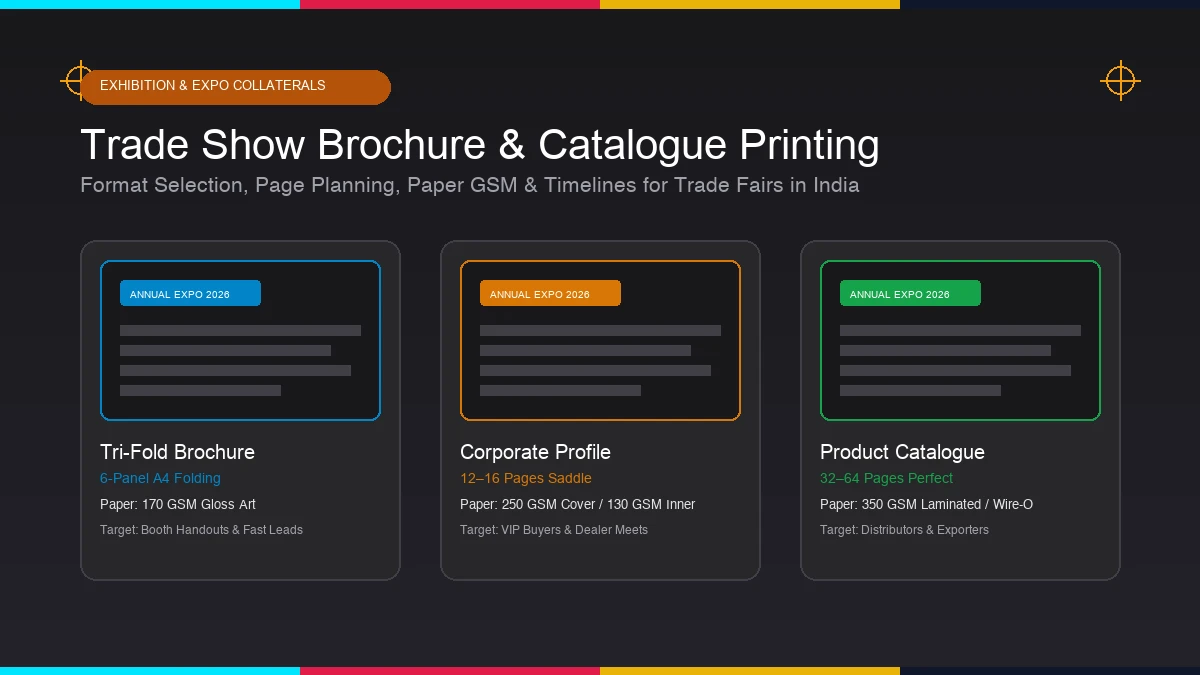
- Tier 1 — High-Volume Handouts (Flyers & Leaflets): Single-sheet A4 or A5 leaflets printed on 130 to 170 GSM gloss or matte art paper. Designed for high foot traffic, quick visual overviews, and QR code redirects to digital landing pages.
- Tier 2 — Commercial Brochures (Bi-Fold / Tri-Fold / 8-Page Folders): Structured presentation documents printed on 210 to 300 GSM art card with thermal lamination. Used for booth meetings with interested prospects looking for company capabilities, certifications, and core service offerings.
- Tier 3 — Comprehensive Product Catalogues: Multi-page publications (32 to 120+ pages) featuring full technical specification tables, dimension schematics, material grade options, and application photos. Reserved exclusively for pre-qualified buyers, procurement managers, channel distributors, and OEM partners.
- Tier 4 — Corporate Profiles: Executive-level 12-to-24 page booklets printed on premium textured or high-bulk natural shade stock with selective spot UV embellishments for executive delegates and investor relations.
2. Page Count Architecture: The Immovable Rule of 4s and 16s
Commercial offset printing does not produce books page-by-page like an office laser printer. Large-format commercial offset presses print large parent sheets (such as 20x30 inches, 23x36 inches, or 25x36 inches) containing 8, 16, or 32 book pages arranged in an imposition layout. After printing, these sheets are machine-folded into "signatures" and assembled.
Consequently, all saddle-stitched (center-stapled) multi-page booklets must have total page counts divisible by 4 (e.g., 8, 12, 16, 20, 24, 28, 32 pages). If a marketing team submits a 14-page PDF document, the printing press must either add two blank pages at the end or remove two pages. For thick, perfect-bound catalogues, page counts are generally optimized in signatures of 16 pages (or 8 pages) to prevent unnecessary paper waste and reduce plate costs.
3. Paper GSM and Surface Selection: Coated Art vs. Matte Art Paper
Paper substrate selection communicates subtle tactile signals about product quality. In commercial printing, paper thickness and weight are quantified in Grams per Square Meter (GSM):
- 130 to 170 GSM Coated Art Paper (Inner Pages): Standard for multi-page catalogues. Provides high opacity, crisp halftone dot reproduction, and smooth ink laydown without making the publication excessively heavy or rigid.
- 210 to 300 GSM Art Card (Brochures & Covers): Heavyweight cardstock ideal for bi-fold folders, presentation sleeves, and the outer covers of saddle-stitched or perfect-bound catalogues. Always requires machine scoring/creasing before folding to prevent paper fiber cracking along the fold.
- Gloss Art Finish: Maximizes color vibrance, specular reflection, and photographic pop. Highly effective for consumer goods, jewellery, fashion, and vibrant food packaging catalogues. However, it can produce harsh glare under intense exhibition hall floodlights.
- Matte / Silk Art Finish: Delivers a sophisticated, non-glare reading surface with subtle tactile resistance. Superior for industrial machinery, technical schematics, financial profiles, and dense product specification tables.
4. Binding Engineering: Saddle Stitch, Perfect Binding, and Wire-O
The mechanical durability of an exhibition catalogue depends directly on selecting a binding style appropriate for its page volume and paper caliper:
- Center Pinning / Saddle Stitching (8 to 48 Pages): The assembled folded signatures are gathered and secured along the spine with two heavy-duty galvanized wire staples. Cost-effective, opens completely flat on meeting tables, and adds zero spine bulk. If page count exceeds 56–64 pages on 130 GSM stock, saddle stitching causes "creep" (inner pages protruding outward), requiring edge trimming.
- Section-Sewn Perfect Binding (48 to 200+ Pages): Signatures are folded, thread-sewn together for strength, and bonded into a squared wraparound card cover using hot-melt polyurethane reactive (PUR) or EVA adhesive. Yields a rigid, bookstore-quality square spine suitable for spine titling, offering maximum structural life during repeated trade consultations.
- Wire-O or Twin-Loop Metal Binding (Manuals & Technical Price Lists): Punched spine with continuous dual-loop metal wire. Permits 360-degree lay-flat opening and backward folding, making it ideal for technical engineers reference manuals or architectural swatch binders on exhibition counters.
5. Pre-Press Proofing and Color Fidelity (CTP Thermal Plates)
A critical test of a professional commercial printer is their pre-press infrastructure. Modern commercial printing relies on Computer-to-Plate (CTP) thermal imaging, where laser diodes burn digital artwork separations directly onto anodized aluminum printing plates at 2400 to 2540 DPI.
Before plates are imaged, brand owners should insist on receiving physical pre-press proofs:
- Calibrated Digital Plotter Proof (Content & Imposition Proof): Verifies correct page sequence, margin clearance, text flow, and image placement. Note that digital inkjets have different color gamut profiles than sheetfed offset litho inks.
- Machine Dummy / Mockup: A blank or rough-printed dummy constructed with the actual specified GSM paper stock, folding, and binding. Allows the marketing manager to physically assess hand-feel, spine thickness, fold alignment, and weight before releasing the production run.
- Machine Progressive Proof / Press Pass: For corporate brands with stringent brand color guidelines (e.g., specific corporate blues or reds), brand representatives can approve the first pull sheet directly at the press console during ink zone calibration.
6. Brochure vs. Catalogue Format Comparison Table
Use this practical comparison table to select the right collateral format, paper weights, and finishing options for your trade show objectives:
| Collateral Format | Typical Page Count | Recommended Paper GSM | Recommended Binding | Trade Show Role | Relative Cost / Unit |
|---|---|---|---|---|---|
| Single Flyer / Leaflet | 2 pages (Front/Back) | 130 – 170 GSM Art | None (Flat cut) | Mass booth traffic handouts | Lowest (₹1 – ₹4) |
| Tri-Fold / Bi-Fold Brochure | 4 to 6 panels | 210 – 300 GSM Card | Creased & Machine Folded | Capability pitches & meetings | Low (₹4 – ₹10) |
| Slim Product Booklet | 8 to 24 pages | Cover: 250 GSM / Inner: 130 GSM | Center Pin (Saddle Stitch) | Featured range presentation | Moderate (₹18 – ₹45) |
| Comprehensive Catalogue | 48 to 160+ pages | Cover: 300 GSM / Inner: 130 GSM | PUR / Section Perfect Bound | High-value B2B buyers & dealers | High (₹65 – ₹180+) |
| Executive Corporate Profile | 12 to 24 pages | 250–300 GSM Textured / Art | Saddle Stitch or Soft Bind | VIPs, investors & dignitaries | Moderate–High (₹40 – ₹95) |
*Note: Cost ranges are illustrative estimates based on typical commercial offset print volumes (1,000–5,000 units) in Indian manufacturing hubs. Exact unit pricing depends on actual page counts, exact paper stock brands, thermal lamination, spot UV, and order volume.
7. Reverse-Engineered 21-Day Pre-Exhibition Production Timeline
The number one cause of trade show collateral failure is compressed production schedules. Quality commercial printing requires sequential mechanical stages: pre-press RIP, CTP plate burning, multi-color offset printing, ink drying and oxidation (12–24 hours), thermal lamination, folding, gathering, binding, three-knife trimming, quality packing in moisture-resistant kraft cartons, and road logistics.
Follow this 21-day reverse schedule before exhibition booth move-in day:
- Day -21 (3 Weeks Out): Finalize product specifications, dimensions, high-resolution product photography (300 DPI at 100% scale), and copy. Freeze revisions.
- Day -16 (Pre-Press Stage): Export PDF/X-1a print-ready files with 3mm bleeds and crop marks. The print house generates CTP digital plotter proofs and blank physical paper dummies.
- Day -14 (Proof Sign-Off): The marketing head conducts thorough structural and content sign-offs on physical plotter proofs. CTP thermal plates are imaged.
- Day -12 to -8 (Printing & Curing): Offset printing on multi-color presses. Sheets are stacked and allowed to cure to avoid ink set-off before subsequent surface finishing.
- Day -7 to -4 (Finishing & Binding): Thermal BOPP lamination, machine folding, collating, stitching or perfect binding, and robotic three-knife trimming.
- Day -3 (Packing & Quality Inspection): Bundling in shrink-wrap (packs of 25 or 50), packing into heavy-ply corrugated cartons with waterproof inner poly-liners, and dispatch via dedicated cargo carrier.
- Day -1 (Venue Delivery): Consignment arrives at hotel or exhibition venue logistics staging area, leaving 24 hours of buffer for booth setup.
8. 10-Point Trade Show Print Procurement Checklist
Before issuing a purchase order to any commercial printer in India for your upcoming exhibition, audit this 10-point technical checklist:
- Page Count Verification: Ensure total pages equal a multiple of 4 (for saddle stitch) or 16/8 (for perfect bound).
- CMYK Color Conversion: Verify that all RGB photographs, digital graphics, and hex color codes have been converted to CMYK (FOGRA39 or Coated GRACoL profiles).
- Image Resolution: Confirm all product photos maintain at least 300 effective DPI at final printed dimensions.
- Bleed & Safe Zone Margins: Maintain a minimum 3mm bleed on all outer edges and keep critical text at least 5mm away from trim lines (and 10mm from perfect-bound spines).
- Barcode & QR Code Legibility: Ensure QR codes to website landing pages are generated in 100% vector K (pure black) rather than rich 4-color black.
- Cover Thermal Lamination: Specify thermal BOPP matte or gloss lamination on outer covers (250+ GSM) to prevent scuffing and spine cracking during transit.
- Paper Mill & GSM Confirmation: Request the specific paper brand and grade (e.g., Century, Bilt, ITC, or imported gloss/matte art paper) in the written quote.
- Physical Dummy Sign-Off: Inspect and approve an unprinted or plotted physical dummy before authorizing mass print run.
- Corrugated Export Packing: Require heavy 5-ply corrugated outer boxes with moisture-barrier liners to prevent carton crushing during multi-city road freight.
- Contingency Delivery Buffer: Schedule delivery at least 48 to 72 hours before booth handover to account for transport delays or interstate checkpost bottlenecks.
9. How to Fairly Compare Printer Quotations in India
When collecting quotations from multiple printing companies, simple headline prices can be profoundly misleading if technical specifications are inconsistent. A lower quote may be masking sub-standard materials:
- Paper Substrate Discrepancies: Ensure all vendors quote on the exact same GSM and brand category. Substituting 115 GSM paper for 150 GSM art paper reduces costs by 15–20% but causes visible show-through (text visible through the opposite side of the page).
- Lamination Technology: Cheap wet (solvent-based) lamination causes edge peeling, bubbling, and noxious chemical odor. Insist on thermal BOPP lamination.
- Binding Durability: For catalogues over 60 pages, standard EVA glue can crack when opened repeatedly. Confirm whether the vendor is using PUR adhesive or section-sewing prior to glue application.
- Packaging and Transport: Verify whether the quote includes GST (typically 12% or 18% depending on classification), carton packaging, and doorstep delivery to the exhibition city.