In an era of cloud enterprise resource planning (ERP) software and digital point-of-sale systems, physical multi-part bill books and invoice books remain an indispensable operational necessity for thousands of businesses across Jaipur and Rajasthan. Wholesale traders in Johari Bazar, marble fabricators in Vishwakarma Industrial Area (VKI), logistics transporters along the Delhi-Jaipur highway, gemstone dealers, automotive service garages, and retail suppliers all rely on carbonless bill books for on-site hand receipts, dispatch delivery challans, loading gate passes, and audit trail backups.
Unlike generic, unbranded stationary store receipts, custom-printed NCR bill books reflect your corporate legitimacy, incorporate mandatory GSTIN compliance data, and prevent handwriting dispute through instant, crisp copy duplication. This comprehensive guide outlines the paper technology, mechanical finishing options, and procurement specifications needed to order custom NCR bill books in bulk across Jaipur.
1. What is NCR Paper? The Chemistry of Micro-Encapsulated Copy
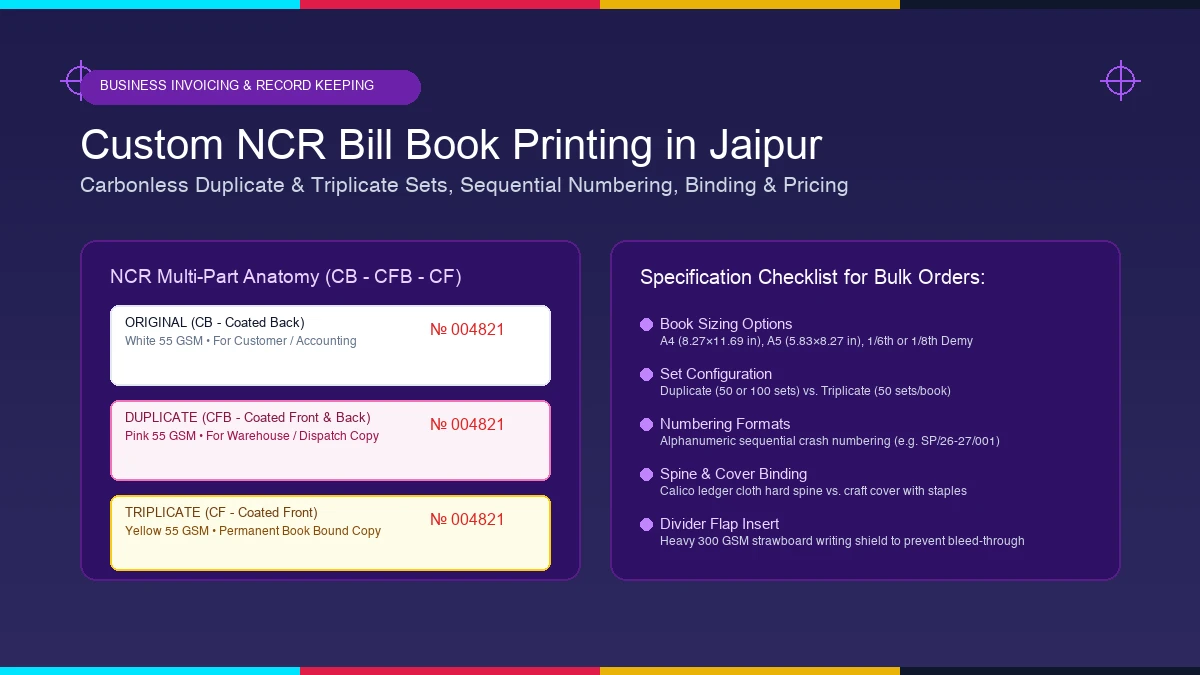
NCR stands for No Carbon Required—a specialized carbonless copy paper developed to replace messy, ink-smearing blue and black carbon paper sheets. The technology relies on a microscopic chemical reaction triggered by pen pressure:
- CB (Coated Back) Sheet: The top white sheet. The underside of this sheet is coated with micro-encapsulated colorless dye precursors suspended in an oil carrier. When a ballpoint pen writes on the surface, the localized mechanical pressure ruptures these microcapsules, releasing the dye downward.
- CFB (Coated Front and Back) Sheet: The middle colored sheet (commonly pink, yellow, or blue) used in triplicate or quadruplicate books. The top side is coated with a reactive clay/acid developer that captures the dye from the sheet above to form a visible dark image, while the bottom side carries microcapsules to transmit pressure to the sheet beneath it.
- CF (Coated Front) Sheet: The bottom sheet of the set. The top face is coated with the color developer to capture the final duplicate image. The reverse side remains uncoated.
Because this chemical reaction requires direct microcapsule contact, NCR papers must be collated in strict chemical order (CB → CFB → CF). High-grade carbonless paper (typically 54 to 56 GSM) produces sharp, smudge-free blue or black image transfer through up to 4 or 5 copies without fading for over 5 to 10 years in archival storage.
2. Duplicate vs. Triplicate vs. Quadruplicate: Architecture & Use Cases
Selecting the appropriate number of parts per set depends entirely on your internal audit and accounting workflow:
- Duplicate Sets (1+1 | 2 Parts): Consists of a White Top Leaf (CB) and a Pink or Yellow Bottom Leaf (CF). Standard workflow: The perforated top leaf is handed to the customer or consignee, while the second leaf remains permanently bound in the book for accounts reconciliation and taxation audits. Ideal for retail stores, receipt vouchers, and service estimates.
- Triplicate Sets (1+2 | 3 Parts): Consists of White (CB), Pink (CFB), and Yellow or Green (CF). Standard workflow: Original White → Customer copy; Second Pink → Transporter / Delivery Challan copy; Third Yellow → Permanent Accounts/Book copy. Essential for B2B wholesale, warehouse dispatches, and manufacturing dispatches.
- Quadruplicate Sets (1+3 | 4 Parts): Consists of White, Pink, Yellow, and Blue leaves. Used in specialized supply-chain logistics, transport bilty consignments, and multi-departmental government contracts where security gate passes, store inventory, accounts, and client receipts must be generated simultaneously.
3. Mandatory Invoice Fields, GST Compliance, and Layout Design
Under Indian GST regulations, commercial tax invoices and delivery challans require precise statutory data points. Before finalizing artwork for custom bill book printing in Jaipur, ensure your template incorporates:
- Corporate Identity & Registration: Legal company name, registered trade address, contact telephone numbers, email, and 15-digit GSTIN clearly visible in the header banner.
- Tax Invoice Identifiers: Distinct fields for "Tax Invoice Number", "Date of Issue", "State Code", and "Place of Supply".
- Buyer / Consignee Details: Name, delivery address, GSTIN/UIN, and state code of the recipient.
- Itemized Transaction Grid: Cleanly ruled columns for Serial Number (Sr. No.), Description of Goods/Services, HSN/SAC Code, Quantity, Unit (e.g., Kgs, Pcs, Mtrs), Rate per Unit, Total Amount, Discount, and Taxable Value.
- GST Tax Breakup: Explicit split columns for CGST + SGST (for intra-state Rajasthan transactions) or IGST (for inter-state dispatches), along with grand total in figures and words.
- Statutory Declarations & Signatures: Standard legal jurisdiction clause (e.g., "Subject to Jaipur Jurisdiction Only"), bank account RTGS/NEFT details for swift payment, and dual signature blocks for "Receiver's Signature" and "Authorized Signatory".
4. Sequential Crash Numbering and Micro-Perforation
Two mechanical processes distinguish an ordinary notebook from a legally compliant commercial bill book:
- Sequential Crash Numbering: Using automated mechanical rotary numbering boxes, books are numbered sequentially (e.g., 0001 to 5000) using heavy strike-pressure and high-contrast red or black letterpress ink. In carbonless books, "crash numbering" is executed so that the mechanical impression forces the number to duplicate chemically onto the second and third sheets simultaneously, guaranteeing 100% numerical matching across all leaves in a set.
- Rotary Micro-Perforation: A precision comb of tiny teeth punches a fine dotted line along the binding margin. The top customer sheet must tear away cleanly with minimal pulling effort, while the bottom audit leaf remains firmly bound without accidental tearing.
5. Book Binding Styles: Calico Cloth vs. Hardboard vs. Pad Gluing
The physical lifespan of a bill book in heavy daily field use depends on the spine binding structure:
- Hardboard Binding with Calico Cloth Spine (The Heavy-Duty Standard): The sets are side-stitched with heavy steel wire staples, backed by a 32–36 oz rigid grey millboard base, covered with a duplex craft cover, and sealed along the spine with reinforced woven calico book-binding cloth tape. Provides an unyielding writing surface even when writing while standing on a shop floor or warehouse dock.
- Soft Cover / Card Binding: Utilizes 250–300 GSM duplex or art card for front and back covers with tape-bound spine. Highly cost-effective for general retail billing desks where books sit flat on counters.
- Glue Padding (Tear-Away Notepads): Sets are edge-glued with specialized carbonless fan-apart adhesive. Allows individual duplicate sets to be snapped off effortlessly without binding wire. Commonly used for restaurant order pads (KOT) and quick delivery receipts.
- Wraparound Writing Shield (Fly-Leaf Insert): An extended card flap attached to the back cover. The cashier folds this flap underneath the current duplicate or triplicate set before writing, preventing the pen pressure from bleeding through and marking subsequent sets underneath.
6. Standard Book Sizes and Paper Specification Matrix
Commercial printers in Rajasthan utilize standard Indian paper sheet divisions (Demy size 18x23 inches or Royal size 20x26 inches) to eliminate paper scrap. The table below outlines standard bill book size options:
| Standard Format Name | Trim Dimensions (Approx.) | Typical Page Orientation | Standard Sets / Book | Primary Commercial Application |
|---|---|---|---|---|
| 1/4 Demy (Large Bill Book) | 8.5 x 11.0 inches (~A4) | Portrait | 50 or 100 sets | Formal GST Tax Invoices, wholesale orders, dispatch biltys |
| 1/6 Demy (Medium Standard) | 7.2 x 9.0 inches | Portrait | 50 or 100 sets | General retail cash memos, job work challans, trading receipts |
| 1/8 Demy (Compact Receipt) | 5.5 x 8.5 inches (~A5) | Landscape or Portrait | 50 or 100 sets | Delivery challans, service garage estimates, jewellery receipts |
| 1/12 or 1/16 Demy (Pocket) | 4.0 x 5.5 inches | Portrait | 50 or 100 sets | Restaurant KOT order slips, courier pickup slips, parking slips |
7. 8-Point Buyer's Bulk Inquiry Specification Checklist
When submitting an inquiry to commercial bill book printers in Jaipur, include this complete 8-point technical checklist to receive an accurate, binding quotation without back-and-forth delays:
- Total Quantity of Books: Specify the exact number of books (e.g., 20, 50, 100, 250, or 500 books).
- Number of Parts per Set: Duplicate (2-part), Triplicate (3-part), or Quadruplicate (4-part).
- Sets per Book: Standard is 50 sets (100 total leaves for duplicate) or 100 sets (200 total leaves for duplicate).
- Trim Book Size: 1/4 Demy (A4 equivalent), 1/6 Demy, 1/8 Demy (A5 equivalent), or custom dimensions in inches.
- Paper Quality: Specify genuine 54–56 GSM NCR Carbonless Paper (state preferred leaf colors: e.g., Top White, Middle Pink, Bottom Yellow).
- Printing Ink Colors: Single color (Standard Reflex Blue, Dark Navy, or Pure Black) vs. Two-Color (e.g., Black body text with Red logo and numbering).
- Numbering Requirements: Starting number and ending sequence (e.g., 001 to 5,000) with crash numbering on duplicate copies.
- Binding & Cover Specifications: Hardboard backing with calico cloth spine tape, wraparound writing shield, and perforated tear-away sheets.
8. Quality Inspection: Transfer Legibility, Registration, and Alignment
When your bulk shipment arrives from the printing press, inspect a random sample of 3 to 5 books across different packing cartons:
- Transfer Pressure Test: Insert the writing shield under Set 1. Write firmly using a standard medium ballpoint pen. Examine the second and third leaves: the duplicated text should appear crisp, dense, and fully legible without smudging or patchy voids.
- Bleed-Through Verification: Verify that the writing shield completely prevented any impression marks on Set 2 underneath.
- Grid and Numbering Registration: Hold a complete set up to a light source. Ensure that the column lines, row dividers, and sequential numbers align across all three leaves. Misaligned grids cause handwritten numbers to fall into the wrong tax columns on duplicate copies.
- Perforation Tear Quality: Tear along the micro-perforation line. The sheet should detach smoothly without tearing into the printed invoice body or ripping the spine tape.
9. How to Compare Bulk Bill Book Quotations in Jaipur
If one quote is significantly lower than competitors in Jaipur, check whether the printer has substituted lower-grade mechanical carbon paper (ordinary paper requiring a loose blue carbon sheet) instead of genuine chemical NCR paper. Furthermore, verify whether the quote includes hardboard binding and sequential numbering, or whether those are tacked on as extra finishing surcharges.
For custom-branded invoice books, explore our dedicated NCR bill book printing services in Jaipur, where you can inspect physical paper grades and discuss your specific GST invoicing needs directly with our technical team in Kartarpura.