In corporate business transactions, legal contracts, executive correspondence, and formal tender bids, printed corporate stationery remains an indispensable physical touchpoint. When a managing director signs an official agreement, an HR department issues an executive offer letter, or a finance officer mails an audited compliance notice, the tactile quality and visual precision of the stationery speak volumes about the organization's institutional stability and operational rigor.
Yet many growing enterprises treat corporate stationery as a series of isolated, reactive purchases—ordering visiting cards from an instant online print-on-demand kiosk, sourcing cheap letterheads from a local neighbourhood copy shop, and purchasing generic unbranded brown envelopes from a stationery vendor. The result is a fragmented brand presence: logo colors that vary across three shades of blue, letterheads that curl and jam inside desktop office laser printers, and envelopes that tear during postal transit. Choosing a competent corporate stationery manufacturer in India requires understanding brand color science, paper caliper compatibility, and professional print engineering.
1. The Corporate Stationery System vs. Disconnected One-Off Printing
A professional corporate identity system is not merely a collection of printed paper; it is an engineered ecosystem where every touchpoint shares identical visual geometry, precise typographic hierarchies, and matched color densities:
- Unified Visual Continuity: When a prospective client receives an executive presentation folder containing a proposal printed on company letterhead, accompanied by the executive's visiting card tucked into a slit pocket, the logo proportions, brand Pantone codes, and paper quality must harmonize perfectly.
- Economies of Consolidated Production: Printing letterheads, envelopes, employee visiting cards, payment vouchers, and presentation folders concurrently in a single production campaign allows commercial printers to optimize press sheets and gang plate setups, reducing overall procurement costs by 20% to 35% compared to purchasing items piecemeal throughout the year.
2. Core Stationery Components and Technical Specifications
Each component within a corporate stationery suite fulfills a specific operational function and demands tailored paper stocks:
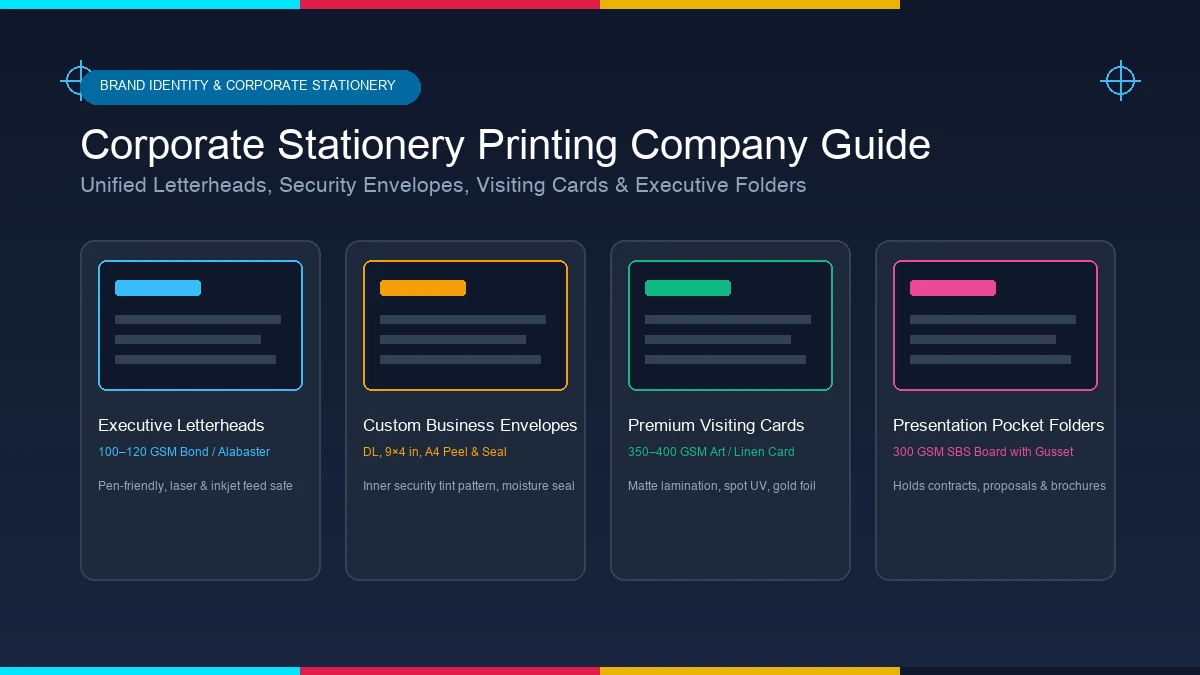
- Executive Letterheads (A4: 210 x 297 mm): Standard office copier paper is 70 to 75 GSM. Premium corporate letterheads utilize 90 to 120 GSM executive bond, alablaster, or natural shade textured paper (e.g., Century, Bilt Royal Executive Bond, or DO parchment). The paper must offer high opacity to eliminate ink show-through, a velvety surface for fountain pen signatures, and rigid sheet flatness for high-speed laser feeding.
- Business Envelopes (DL, C5, C4 Formats): Must be fabricated from durable 100 to 120 GSM maplitho or bond paper with precision die-cutting, crisp folded creases, and secure peel-and-seal adhesive releases.
- Corporate Visiting Cards (Standard: 89 x 54 mm or 90 x 50 mm): Printed on rigid 350 to 400 GSM art card stock with thermal matte lamination. The card must withstand heavy handling inside pockets and wallets without corner fraying or edge delamination.
- Presentation Folders (Interlocking or Glued Pocket): Printed on 300 to 350 GSM coated art card with thermal matte lamination, customized with dedicated internal die-cut slots to securely hold business cards and multi-page contract sheets.
3. Brand Color Consistency across Coated and Uncoated Substrates
Maintaining brand color fidelity is the most complex technical hurdle in corporate stationery manufacturing. The primary challenge stems from the physics of paper absorption:
Visiting cards and presentation folders are typically printed on coated art paper, where ink sits on the surface micro-coating, reflecting maximum light and yielding punchy, saturated colors. In contrast, letterheads and envelopes are printed on uncoated porous bond paper, where liquid ink absorbs deep into the cellulose fibers, scattering light and reducing apparent color saturation.
A master commercial printing partner overcomes this through rigorous color calibration:
- Separate Color Profile Curves: Applying ISO 12647-2 press curves tailored specifically for uncoated offset papers (FOGRA47) and coated art cards (FOGRA39).
- Pantone Matching System (PMS) Formulas: For brand colors with zero tolerance for variation (such as corporate telecom reds or banking navies), utilizing dedicated spot inks mixed according to Pantone Uncoated (U) and Coated (C) formulas rather than standard 4-color process CMYK builds.
4. Office Printer Compatibility: Preventing Laser Toner Meltdown
A critical quality defect occurs when letterheads printed by a commercial printer are subsequently fed into desktop office laser printers (HP, Canon, Brother, Xerox) to overprint contracts or letters:
The Laser Fuser Hazard:
Office laser printers pass paper through a fuser heating roller operating at temperatures between 180°C and 210°C under intense mechanical pressure to melt plastic toner powder onto the page. If the commercial printer used low-grade offset inks with high solvent or wax content, the intense fuser heat re-melts the pre-printed company logo, causing it to offset onto the laser printer's heated rubber drum, blister the paper, or leave smudged ghost images across subsequent pages.
Commercial printers specializing in corporate stationery formulate letterheads using heat-resistant, low-wax offset litho inks and allow an extended 48-hour oxidation cure before packing. This guarantees that letterheads feed through high-volume office copiers and laser printers smoothly without paper curl, toner ghosting, or feeder roller jamming.
5. Envelope Engineering: Peel-and-Seal, Window Cuts & Security Tint
Business envelopes serve both communication and security functions. When evaluating envelope manufacturing capabilities, examine three engineering specifications:
- Peel-and-Seal Flap (Release Liner Tape): Traditional moisture-activated gum requires licking or a sponge dampener, which deteriorates during storage and often fails to seal completely. Industrial peel-and-seal uses a protected silicone release paper over a permanent hot-melt pressure-sensitive adhesive. The user simply strips the paper and presses the flap down, creating a permanent tamper-evident bond that has a shelf life of over 18 to 24 months.
- Interior Security Hatching (Privacy Tint): For mailing confidential salary slips, bank statements, or legal notices, envelopes must feature an internal printed pattern (a dense micro-mesh or dark blue/grey abstract geometric security hatch). This prevents unauthorized parties from reading the contents by holding the envelope up to a backlight.
- Address Window Engineering: When printing envelopes for automated mailing machines or transactional billing, transparent poly film windows must be bonded cleanly along the perimeter without glue bleed, ensuring address letters slide in without snagging.
6. Corporate Stationery Ecosystem Specifications Table
Review the complete specifications matrix below when organizing your organization's annual stationery procurement:
| Stationery Item | Standard Trim Size | Recommended Paper Stock | Surface / Sealing Style | Primary Commercial Role |
|---|---|---|---|---|
| Executive Letterhead | A4 (210 x 297 mm) | 100 – 120 GSM Royal Bond / Alablaster | Smooth uncoated, heat-cured offset ink | Legal contracts, executive proposals, offer letters |
| Standard Office Letterhead | A4 (210 x 297 mm) | 90 – 100 GSM Super Maplitho | High opacity, laser & inkjet certified | High-volume departmental documentation, memos |
| Executive DL Envelope | 4.25 x 8.75 in (110 x 220 mm) | 100 – 120 GSM Executive Bond | Peel-and-seal flap, interior security tint | Folded A4 letterhead mailing, payment cheques |
| C5 / C4 Document Envelope | C5 (9x6 in) / C4 (10x12 in) | 120 GSM Maplitho or Kraft | Peel-and-seal flap, side-seam construction | Mailing flat proposals, catalogues, legal dossiers |
| Corporate Visiting Card | 89 x 54 mm | 350 – 400 GSM Art Card | Thermal matte lamination + spot UV on logo | Professional networking, sales representation |
| Presentation Folder | 9.0 x 12.0 in (Closed) | 300 – 350 GSM Art Card | Thermal matte lamination + card slit pocket | Boardroom pitches, client onboarding dossiers |
7. Pre-Press Setup: Vector Assets, Margins, and Bleed Controls
Corporate identity stationery requires meticulous pre-press file preparation. Because letterheads contain dense micro-typography (address lines, registration numbers, ISO accreditations), follow these strict standards:
- 100% Vector Logos & Typography: Never place raster JPEG or PNG logos into stationery artwork. Logos, emblems, and icons must remain pure vector curves (EPS, AI, or vector PDF) to ensure pin-sharp edges at high imaging resolutions.
- Minimum Line Weight & Font Sizing: Micro-legal text in footers should never fall below 6pt font size. Fine vector rules or crest lines must maintain a minimum stroke thickness of 0.25pt (0.5pt for reversed-out white lines) to prevent disappearing during plate imaging.
- Printer Margins for Office Desktop Overprinting: When designing letterheads, maintain a clear 15mm unprinted margin along the top, left, and right edges, or ensure your pre-printed header graphics do not interfere with standard office printer grip margins.
8. Corporate Stationery Procurement & Branch Order Checklist
Before releasing corporate purchase orders, review this 10-point stationery procurement checklist:
- Centralized Volume Forecasting: Aggregate annual stationery usage across headquarters and branch regional offices to leverage bulk offset volume pricing.
- Laser Compatibility Guarantee: Confirm in writing that letterhead inks are heat-cured litho formulations safe for 200°C laser printer fusers.
- Paper Brand and GSM Explicitly Named: Ensure the purchase order specifies the exact mill paper brand (e.g., Century Royal Bond, Bilt Alablaster, or equivalent Grade-A stock).
- Color Fidelity Standard: Specify exact Pantone spot numbers or approved CMYK targets across all items in the suite.
- Peel-and-Seal Shelf Life: Confirm envelopes feature hot-melt adhesive with silicone release liner rather than water-activated gum.
- Interior Privacy Hatching: Verify security envelopes have opaque internal printed patterns for confidential mailings.
- Visiting Card Lamination: Ensure 350+ GSM business cards receive thermal BOPP matte film to prevent edge scuffing.
- Physical Proof Approval: Review a printed proof sheet on the actual specified paper stock before authorizing mass production.
- Moisture-Proof Poly Packaging: Require letterheads to be shrink-wrapped in moisture-barrier packs of 250 or 500 sheets inside rigid shipping cartons.
- Multi-Branch Scheduled Dispatch: Verify the printer possesses logistics capability to pack and dispatch distinct branch consignments across Indian destinations.
9. How to Fairly Evaluate Commercial Stationery Quotations
When comparing quotations from corporate stationery printing suppliers in India, ensure that all bids are normalized for substrate grade and fabrication technique. A supplier quoting 80 GSM standard maplitho paper will always undercut a supplier quoting 100 GSM executive watermark bond. Similarly, envelopes made by hand with cheap water gum cannot be compared to automated die-cut peel-and-seal envelopes.
For organizations seeking verified commercial manufacturing in Rajasthan, review our dedicated letterhead printing in Jaipur and corporate stationery services, where you can inspect actual paper swatches, review sample envelope peel-and-seal bonds, and discuss unified brand printing directly at our facility in Kartarpura, Bais Godam.