For food and beverage manufacturers in India, a product label is much more than a visual sales pitch—it is a functional component of the packaging assembly. When an artisanal iced tea bottle is pulled from an ice chest, a gourmet yoghurt cup sits in a humid dairy display, or frozen organic meat is transported across cold-chain distribution, the label encounters moisture, condensation, friction, and extreme thermal swings. If the label softens, wrinkles, flags at the corners, or bleeds ink, the brand's perceived quality collapses immediately.
Selecting a commercial label converter in India requires understanding the distinction between superficial surface water resistance and genuine immersion-grade waterproofing. This technical guide explains the material science, adhesive chemistries, container dynamics, and commercial criteria that food and beverage brand owners should review before committing to bulk label production.
1. The Truth About "Waterproof" Labels vs. Moisture-Resistant
In the Indian commercial printing market, the term "waterproof" is frequently misused. Many print brokers market coated paper stocks finished with aqueous varnish or UV varnish as "waterproof." In reality, paper is cellulose-based; once water vapor penetrates the edge seams or micro-cracks in the varnish, cellulose fibers absorb water, expand, and tear. Paper with varnish is only water-resistant or splash-resistant—it is never truly waterproof.
A truly waterproof label system requires three synchronized elements working as a unified barrier:
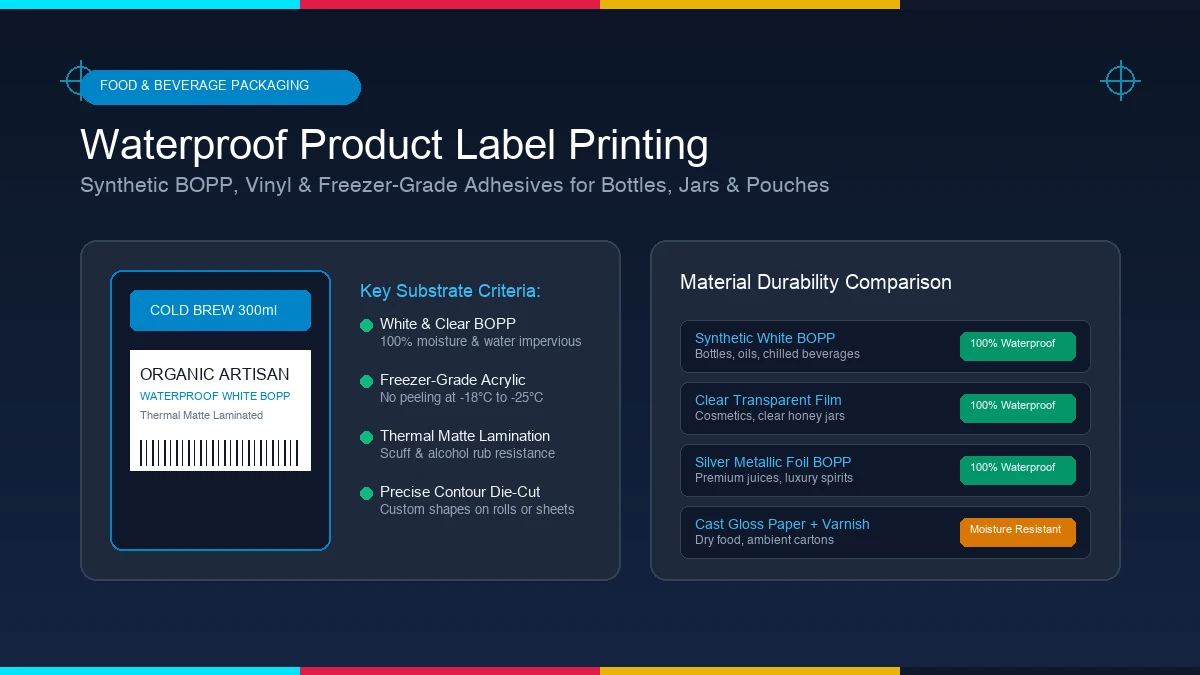
- 100% Synthetic Non-Cellulosic Facestock: Plastic polymer films such as BOPP (Biaxially Oriented Polypropylene), Polyethylene (PE), or Vinyl that cannot absorb moisture.
- Water-Impervious Adhesive Matrix: Acrylic emulsion or synthetic rubber hot-melt adhesive that does not re-emulsify, whiten, or lose shear strength when exposed to condensation.
- Continuous Polymer Barrier: Thermal film lamination (matte or gloss BOPP film) fused over the cured inks to permanently seal pigments against moisture wiping, ice water immersion, and oil contact.
2. Selecting the Right Substrate: BOPP, Vinyl, and Polyester
Commercial label converters supply several synthetic substrates, each engineered for distinct food and beverage packaging dynamics:
A. White BOPP (Biaxially Oriented Polypropylene)
White BOPP is the workhorse of the modern beverage and chilled food packaging industry. It offers exceptional tensile strength, crisp white opacity, brilliant color reproduction, and complete dimensional stability in water. Because BOPP is biaxially stretched during manufacturing, it resists stretching or tearing during high-speed automated label application. It is ideal for rigid glass bottles, PET beverage containers, sauce jars, and plastic condiment bottles.
B. Clear / Transparent BOPP ("No-Label Look")
Clear BOPP film delivers the elegant "direct-on-glass" visual aesthetic popular with cold-pressed juices, premium craft sodas, kombuchas, and artisanal honey. Prepress preparation for clear film requires a specialized opaque white ink understrike (White + CMYK) beneath text and illustrations to prevent colors from appearing translucent against dark liquids.
C. Metalized Silver BOPP / Foil Film
When brands want metallic accents, gold foil reflections, or jewel-toned beverage branding without expensive hot foil stamping dies, metalized silver BOPP is the optimal choice. By printing transparent CMYK inks over the reflective silver base, printers can produce unlimited metallic hues (champagne gold, ruby, copper, emerald) while maintaining 100% water barrier protection.
D. Flexible Vinyl & PE (Polyethylene) for Squeeze Packaging
If your product is packaged in a flexible squeeze bottle (mayonnaise, honey, ketchup, salad dressing), rigid BOPP will develop permanent creases when squeezed. Polyethylene (PE) and cast vinyl films have elastic polymer chains that stretch and rebound when the bottle is compressed, preventing unsightly label wrinkles and edge lifting.
3. Adhesive Science: Moisture, Condensation, and Deep Freeze
A waterproof film substrate is useless if the adhesive fails. Adhesives in food and beverage packaging face three severe stressors:
- Condensation ("Sweating"): When chilled bottles are removed from refrigerators into warm Indian ambient air (30°C to 42°C), moisture vapor rapidly condenses on the container walls. General-purpose water-based adhesives can turn milky and lose tack, causing the label to slide or detach. Chilled beverages require moisture-tolerant emulsion acrylics.
- Sub-Zero Freezing (-18°C to -25°C): Standard adhesives crystalize and lose tack when frozen, causing labels on ice cream tubs, frozen seafood, or frozen ready-meals to snap off. Freezer-grade adhesives remain pliable and maintain adhesive bond strength across a wide thermal window (-40°C to +70°C).
- Oils, Fats, and Acid Exposure: Edible cooking oils, ghee, fruit juices, and vinegar dressings easily drip onto outer labels during dispensing. Food label adhesives must resist chemical degradation from edible lipids and mild acids.
4. Container Surface Energy: Glass, PET, Pouches, and Tins
The surface tension (measured in dynes/cm) of your packaging container determines how well the label adhesive will "wet out" and bond:
- Glass Bottles & Jars (High Surface Energy): Generally provide superior initial tack. However, glass surface coatings (hot-end and cold-end lubricity coatings applied by bottle manufacturers) can severely reduce adhesion unless a high-tack adhesive is specified.
- PET & HDPE Plastics (Medium-to-Low Surface Energy): HDPE milk jugs and plastic oil containers require aggressive acrylic or rubber-based adhesives formulated for non-polar plastics.
- Stand-Up Pouches & Flexible Laminates: Pouches often flex and warp during transit. Labels applied across pouch gussets require flexible films that adjust to internal pouch pressure.
5. Print Clarity, Color Consistency, and Barcode Scannability
Food packaging labels in India must satisfy statutory Food Safety and Standards Authority of India (FSSAI) labelling regulations. This includes legible nutritional tables, mandatory FSSAI license numbers with logos, net quantity, batch numbers, expiry dates, and GS1 EAN-13 barcodes.
When labels are exposed to condensation, water droplets act as miniature lenses. If print resolution is soft or ink density is uneven, retail laser scanners and automated warehouse barcode readers will fail to scan the product. High-performance label printing requires:
- Pure 100% Black (K) for Barcodes: Never print barcodes using 4-color rich black (CMYK). Misregistration of even 0.05mm can blur barcode lines and cause retail checkout scan rejections.
- Minimum 60-Degree Barcode Quiet Zones: Ensure at least 2.5mm of clear white background on both lateral ends of the barcode.
- UV-Cured & Lightfast Inks: UV-curable inks cross-link instantly into a solid polymer web under UV lamps, preventing ink bleeding when submerged in water or wiped with damp cloth.
6. Protective Over-Laminations: Thermal Matte vs. Gloss
The topmost protective layer determines the tactile feel, glare resistance, and durability of the finished label:
Thermal Gloss Lamination
High-reflectivity crystal clear film that amplifies color saturation, deepens black contrast, and produces a shiny, glass-like finish. Excellent for chilled beverages, fruit squashes, energy drinks, and products displayed in refrigerated glass cases under bright supermarket lights.
Thermal Matte / Velvet Lamination
Zero-glare, satiny soft-touch surface that exudes premium organic, gourmet, or artisanal aesthetic. Eliminates harsh overhead lighting reflections, making fine nutritional typography and certification badges effortlessly readable from all angles.
7. Substrate Comparison Table for Food & Beverage
Use this technical reference matrix to evaluate substrates against your specific packaging environment:
| Substrate Material | Waterproof Rating | Temperature Range | Oil & Acid Resistance | Best Food & Beverage Use Case | Relative Cost |
|---|---|---|---|---|---|
| White Synthetic BOPP | 100% Waterproof | -20°C to +80°C | Excellent | Chilled bottles, beer, kombucha, dairy cups, sauces | Moderate |
| Clear Transparent BOPP | 100% Waterproof | -15°C to +75°C | Excellent | No-label look on glass juice bottles, infused oils, honey | Moderate to High |
| Silver Metallic BOPP | 100% Waterproof | -15°C to +80°C | High | Luxury spirits, premium syrups, metallic energy drinks | Premium |
| Polyethylene (PE) Film | 100% Waterproof | -30°C to +70°C | Very High | Squeeze bottles, ketchup, mayonnaise, liquid soaps | Moderate to High |
| Coated Chromo Paper + Varnish | Moisture-Resistant Only | 0°C to +60°C | Low | Dry grocery boxes, bakery bags, ambient spice jars | Economical |
8. Food & Beverage Pre-Order Checklist
Before confirming a production run with your label printer, run through this 10-point checklist:
- ☑ 1. Packaging Substrate: Glass, PET, HDPE, Polycarbonate, or Tinplate?
- ☑ 2. Application Method: Manual hand application or automated high-speed roll applicator? (Affects roll core size: 25mm, 40mm, or 76mm, and winding direction).
- ☑ 3. Environmental Extremes: Will the container be submersed in an ice bath bucket, placed in deep-freeze (-20°C), or pasteurized with hot water wash?
- ☑ 4. Shelf Life & Transit: Expected shelf life (6 months to 24 months) and transit across high-humidity monsoon regions.
- ☑ 5. Vector Artwork & Bleed: All key text converted to vector curves with minimum 2mm outer bleed and 2mm inner safe margin.
- ☑ 6. Barcode Compliance: 100% black (K) barcode with verified GS1 dimensions and quiet zones.
- ☑ 7. FSSAI & Legal Text Legibility: Font size compliant with mandatory statutory labelling standards (minimum 1mm to 2mm x-height).
- ☑ 8. Batch Coding Compatibility: If imprinting MRP, batch number, and expiry date via thermal transfer or inkjet ribbon, ensure a dedicated uncoated or non-laminated matte varnish window is preserved.
- ☑ 9. Physical Wet Sample Testing: Request printed sample proofs applied to actual bottles and submerge them in ice water for 24 hours.
- ☑ 10. Order Quantities & Staggered Deliveries: Verify MOQ per SKU to balance economies of scale against regulatory label changes.
9. How to Fairly Compare Printer Quotations in India
When comparing quotations from different label printing companies in India, beware of unbundled cost discrepancies. Always confirm:
- Brand of Substrate: Reputable converters use standardized self-adhesive labelstock from certified manufacturers like Avery Dennison, UPM Raflatac, or Cosmo Films. Generic unbranded stocks frequently exhibit adhesive batch variability.
- Tooling & Flexible Die Charges: Custom label shapes require flexible magnetic rotary dies. Confirm whether die-tooling charges are one-time costs or included in the unit price.
- Lamination Film Thickness: Ensure your converter specifies 15 to 20 micron thermal BOPP film rather than 10 micron cheap chemical coatings.
- GST & Logistics: Confirm whether quotes are inclusive of 18% GST and specify delivery terms to your bottling plant.