
Types of Visiting Cards: Best Quality at Affordable Prices in Jaipur
In an increasingly digital business ecosystem, a well-crafted physical visiting card remains one of the most immediate and influential touchpoints your brand can offer. Whether exchanging contacts across a boardroom table in Jaipur, introducing products at an industrial trade expo in Sitapura, or greeting clients at a retail showroom on MI Road, your visiting card delivers critical contact details, creates an enduring professional impression, and reinforces corporate brand recognition.
However, securing bulk visiting card printing in Jaipur that combines tactile excellence with cost-efficiency requires more than picking a layout from a web template. The perceived value and physical resilience of your business card stem from deliberate choices in paper stock density (GSM), surface lamination films, ink reproduction precision, and post-press enhancements.
At Shekhawati Printers, located at Kartarpura, Bais Godam, Jaipur, we manufacture commercial stationery and corporate identity collaterals on industrial offset and digital press lines. We serve businesses seeking reliable, high-volume production without inflated broker margins or exaggerated promotional claims. In this guide, our prepress and production specialists break down every popular visiting card type, provide an actionable decision framework for diverse business sectors, share insider cost-saving techniques, and explain how to streamline bulk orders across Jaipur and Rajasthan.
Table of Contents
- 1 Different Types of Visiting Cards
- 2 Which Visiting Card Is Best for Your Business?
- 3 Recommendations by Industry & Team
- 4 Quality at an Affordable Price
- 5 Why Order Visiting Cards in Bulk?
- 6 Bulk Printing in Jaipur & Rajasthan
- 7 Information Needed for a Quote
- 8 Common Mistakes to Avoid
- 9 Frequently Asked Questions
Different Types of Visiting Cards
Selecting the ideal card requires understanding the physical characteristics, tactile sensation, visual appearance, and manufacturing considerations of each substrate and finishing technique. Below are the 10 core visiting card formats produced for commercial clients:
Standard Matte Visiting Cards
Features a smooth, non-reflective surface that eliminates harsh specular reflections under office fluorescent lighting. Clean, sober, and remarkably easy to read.
- Tactile feel: Smooth, natural paper texture with low sheen.
- Best suited for: Everyday business networking, sales executives, and standard office correspondence.
- Key benefit: Easy to jot notes or additional numbers on with standard ballpoint pens.
Glossy Visiting Cards
Treated with a high-gloss aqueous or UV varnish that deepens solid ink density and makes full-color graphics, photographs, and logos pop with vibrant saturation.
- Tactile feel: Slick, reflective, polished surface.
- Best suited for: Retail businesses, jewelers, beauty salons, photographers, and creative showcases.
- Key benefit: Accentuates high-contrast CMYK color gradients and imagery.
Matte-Laminated Visiting Cards
An imported thermal polypropylene matte film is bonded to the printed cardstock under heat and pressure, imparting a soft, velvet-like touch and superior structural strength.
- The crucial difference: Unlike raw matte paper, matte lamination seals the substrate against moisture, ink scuffing, and corner fraying.
- Best suited for: Corporate leadership, consultants, legal advisors, architects, and multi-tier company kits.
- Key benefit: Exceptional durability; retains a fresh, crisp look inside wallets for months.
Gloss-Laminated Visiting Cards
Combines the intense color brilliance of high-gloss optics with the impenetrable physical barrier of thermal plastic film lamination.
- Tactile feel: Ultra-smooth, glass-like protective exterior.
- Best suited for: Heavy-circulation commercial cards, food & hospitality services, and high-impact retail branding.
- Key benefit: Completely wipeable surface that resists liquid spills, grease, and pocket humidity.
Textured Visiting Cards
Milled with organic surface patterns such as linen, laid, felt, canvas, or woodgrain. Delivers an immediate physical sensation of craftsmanship and heritage upon touch.
- Tactile feel: Artisanal, ribbed, or woven dimensional paper texture.
- Best suited for: Boutique design studios, interior designers, heritage hotels, and high-end wedding planners.
- Key benefit: Leaves a memorable sensory impression that digital communications cannot replicate.
Premium Thick Visiting Cards (350–400+ GSM)
Crafted from ultra-dense imported SBS paperboard or multi-ply bonded sandwich duplex boards. It resists any bending, creasing, or edge curling.
- Tactile feel: Substantial, heavy, unbending hand feel that conveys stability.
- Best suited for: Managing directors, C-suite executives, senior legal counsel, and luxury brands.
- Key benefit: Projects institutional solidity and premium standards before a single word is read.
Spot UV Visiting Cards
Applies a clear, liquid polymer resin onto selective design areas (such as logos, owner names, or background geometric patterns) over a velvety matte-laminated foundation, cured instantly with UV light.
- Visual contrast: The striking interplay between reflection-free matte and mirror-like glossy raised elements creates dramatic depth.
- Best suited for: Modern technology companies, architecture firms, marketing agencies, and executive branding.
- Key benefit: Directs the recipient’s gaze immediately to your brand emblem or corporate symbol.
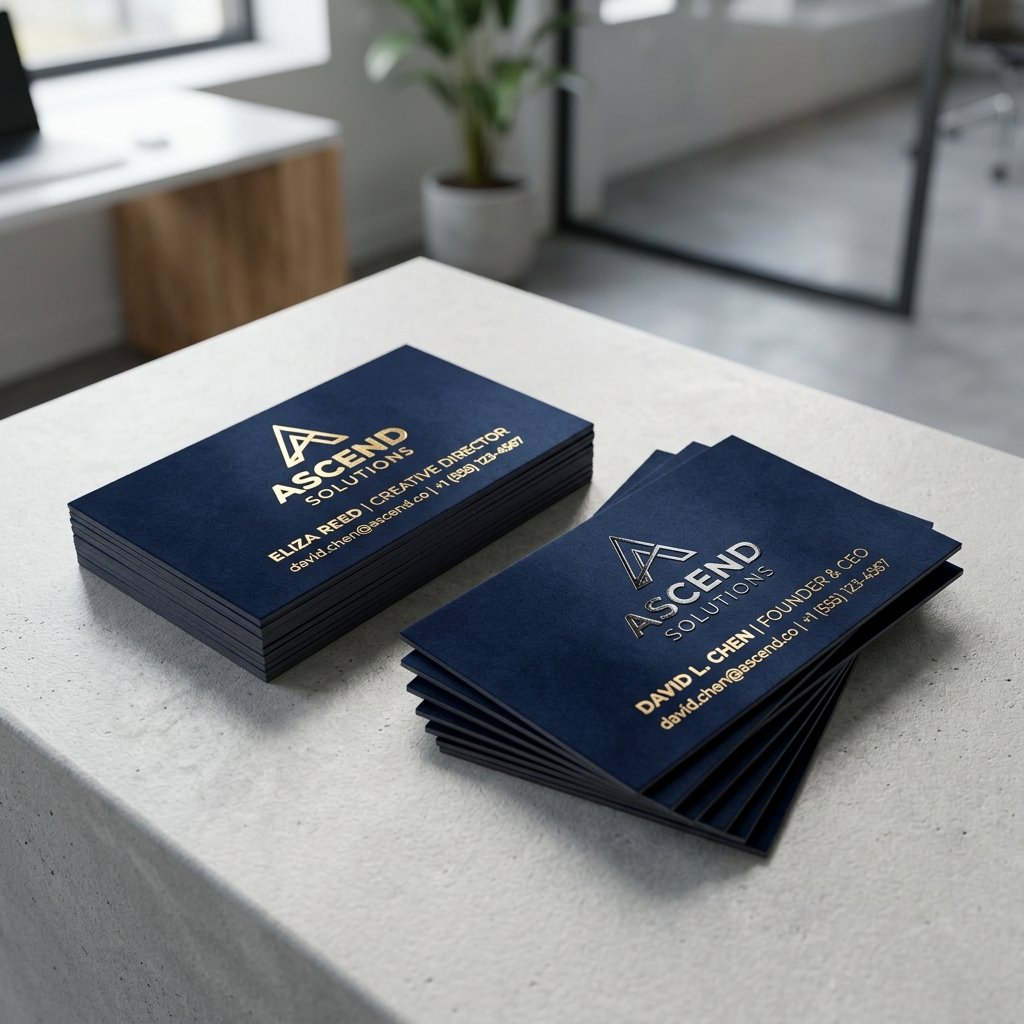
Embossed or Foil-Accented Visiting Cards
Utilizes custom-machined brass or magnesium dies to physically raise paper fibers (blind embossing) or fuse shimmering metallic foil (gold, silver, copper, or rose gold) under heat and pressure.
- Appearance: Opulent metallic luster and dimensional physical relief that catches room light.
- Best suited for: Heritage jewelry houses, luxury real estate developers, fine dining, and elite advisory firms.
- Key benefit: Unmistakable mark of bespoke prestige and elevated craftsmanship.
Minimalist Corporate Visiting Cards
Focuses on rigorous typographic hierarchy, generous whitespace, structured brand color palettes, and frictionless contact information without distracting ornamentation.
- Appearance: Disciplined, modern, highly legible, and universally professional.
- Best suited for: Corporate enterprises, chartered accountants, engineering consultancies, and multi-location branch networks.
- Key benefit: Maximizes speed of reading phone numbers, email addresses, and designation details.
Custom-Designed Visiting Cards
Completely tailored to your specifications—incorporating custom die-cut rounded corners, unique dimensions (e.g. 90×54mm or square 65×65mm), folding tent formats, or embedded vCard QR codes.
- Features: Exact Pantone brand matching, rounded safety corners, and instant smartphone contact-saving QR codes.
- Best suited for: Digital marketing agencies, tech startups, e-commerce brands, and forward-thinking entrepreneurs.
- Key benefit: Bridges physical handshakes with immediate digital phonebook additions and portfolio views.
Which Visiting Card Is Best for Your Business?
Selecting the best visiting card involves balancing brand expectations against real-world usage and procurement budgets. To assist procurement managers, shop proprietors, and business founders, we have synthesized the key parameters into this practical comparison matrix:
| Card Type | Visual Appearance & Texture | Best Suited For | Relative Cost Level | What to Confirm Before Ordering |
|---|---|---|---|---|
| Standard Matte | Smooth, non-reflective, natural paper feel | Everyday business, mass promotional networking | Budget-Friendly | Paper GSM (300 vs 350 GSM) & single vs double side |
| Glossy Coated | Shiny, highly reflective, vibrant color pop | Retail stores, salons, color-dense photography | Budget-Friendly | Image resolution (300+ DPI) & fingerprint sensitivity |
| Matte-Laminated | Silky, velvet smooth, glare-free, tear-resistant | Corporate offices, consultants, executives, CAs | Mid-Range (Popular) | Board weight (350 GSM recommended) & thermal film bond |
| Gloss-Laminated | Glassy, ultra-bright, moisture & grease resistant | Hospitality, field staff, high-churn retail cards | Mid-Range | Pen writability constraints & edge trimming alignment |
| Textured Linen / Laid | Tactile ribbed, woven or felt organic paper surface | Boutique designers, luxury hospitality, architects | Premium | Substrate stock availability & legibility of fine text |
| Premium Thick (350–400+ GSM) | Substantial, rigid, heavy hand feel, unbendable | Founders, directors, luxury brands, legal counsel | Premium | Board caliper, box packaging, and turnaround schedule |
| Spot UV Laminated | Velvet matte background with raised glossy accents | Tech startups, creative agencies, brand logos | Premium | Separate vector Spot UV mask file & minimum gang volume |
| Embossed / Gold Foil | Dimensional physical relief and reflective metal foil | Jewelers, high-end developers, elite corporate kits | Ultra-Premium | Custom brass die tooling charges & registration limits |
*Note on Cost Levels: Terms like "budget-friendly", "mid-range", or "premium" represent relative category guidance. The final commercial price per thousand cards depends strictly on total order volume, paperboard caliper, color sides (4/0 vs 4/4), custom die cuts, and delivery destination.
Tailored Card Recommendations for 7 Key Business Sectors
Retailers & Shop Owners
Recommendation: 350 GSM Gloss-Laminated or Matte-Laminated cards with double-sided printing. Feature your store logo, proprietor phone number, store address, GSTIN, and a bold WhatsApp QR code for product inquiries or catalog links. Lamination protects against moisture and repeated pocket handling.
Startups & Small Businesses
Recommendation: 350 GSM Velvet Matte-Laminated cards with clean typography and a crisp digital vCard QR code on the reverse. If budget permits, add Spot UV highlights to your brand emblem to signal tech-forward sophistication during investor pitches and networking meetups.
Real Estate Professionals & Brokers
Recommendation: Heavy 350–400 GSM imported art board with velvet matte lamination and gold hot-foil or Spot UV highlights. In real estate, tactile weight translates subconsciously to financial security and reliability when handling high-value land, residential, or commercial transactions.
Corporate Offices & Sales Teams
Recommendation: Standardized 350 GSM matte-laminated cards pooled across departmental batches (500–1,000 cards per employee). Maintain strict corporate color reproduction and typographic hierarchy across sales reps, department heads, and regional executives.
Manufacturers & Distributors
Recommendation: Stiff 350 GSM double-sided matte cards detailing factory works address, warehouse logistics, export-import code (IEC), GST details, and major product lines. Pair with matching corporate letterheads and NCR bill books.
Consultants, CAs & Legal Practitioners
Recommendation: Minimalist layouts on 350 GSM natural matte or premium textured linen board. Avoid loud glossy coatings; prioritize generous margins, elegant serif or clean sans-serif typefaces, and understated gravitas that builds client confidence.
Event Organisers & Creative Agencies
Recommendation: Custom-designed square formats (65×65mm) or full-bleed Spot UV patterns with soft-touch velvet lamination. Demonstrates your creative execution prowess and physical attention to detail from the very first introduction.
How to Get Good-Quality Visiting Cards at an Affordable Price
Procuring premium-feeling cards without exceeding your budget is not about hunting for artificial "cheap" deals—it is about smart production planning. Follow these 8 practical cost-saving strategies:
- 1. Select paper and finish matching actual usage: Avoid over-specifying expensive foil stamping or textured stocks for mass street promotional handouts where simple 300 GSM cards suffice. Reserve luxury 400 GSM Spot UV cards for targeted business development meetings.
- 2. Order in planned bulk batches: Due to fixed offset press setup costs (making aluminum CTP plates, mixing inks, setting cutting dies), printing 2,000 or 5,000 cards in one planned run yields a significantly lower per-card rate than ordering 200 cards repeatedly every month.
- 3. Standardise designs across all staff members: By keeping the master card dimensions, typography, paper stock, and finish uniform across all company executives, your printer can group employee cards into a single production sheet, avoiding redundant make-ready charges.
- 4. Supply print-ready vector artwork: Provide high-resolution vector PDF, CorelDRAW (.CDR), or Adobe Illustrator (.AI) files with exact dimensions and 3mm bleed. Supplying imperfect artwork that requires extensive prepress rework often incurs avoidable designer fees.
- 5. Thoroughly proofread before production approval: Re-printing 2,000 cards because of a single misplaced digit in a phone number or a misspelled email address is the single most common and costly mistake in commercial printing. Always have two independent team members proofread proofs.
- 6. Compare quotes on identical specifications: Never compare quotations on headline price alone. Confirm that both suppliers are quoting identical parameters: exact paper GSM (e.g. 350 GSM imported art board vs 250 GSM domestic board), board type, thermal lamination grade, and cutting precision.
- 7. Ask for physical samples or digital proofs: Visit the factory or request printed paper swatches to verify the board stiffness and texture before authorizing a major corporate run.
- 8. Confirm delivery schedules in advance: Ordering with standard production turnaround (typically 2 to 4 working days for commercial offset gang runs) avoids emergency overnight expedite surcharges.
Why Order Visiting Cards in Bulk?
For growing businesses, retail enterprises, and corporate sales forces, batching visiting card requirements into planned bulk orders offers distinct operational and financial advantages:
Streamlined Purchasing
One coordinated purchase order simplifies accounting, reduces repetitive vendor follow-ups, and ensures the procurement department secures consolidated invoicing.
Absolute Brand Uniformity
When multiple employee cards are printed on the same offset press sheet, every single card receives the identical ink density, color balance, and lamination sheen.
Offset Production Economies
Commercial offset gang-run printing spreads fixed prepress setup and plate costs across thousands of cards, allowing a substantially lower unit cost per card.
Reliable Buffer Inventory
Maintains an uninterrupted card supply in office stock, preventing your sales reps or field agents from running out of cards before vital customer presentations or expos.
Important Pricing Note: Actual commercial pricing varies based on exact board caliper, single versus double-sided artwork, custom finishes, and raw paper market rates. All bulk jobs are quoted individually upon specification review.
Bulk Visiting Card Printing in Jaipur and Across Rajasthan
Shekhawati Printers operates an industrial commercial printing facility located at F-93, Kartarpura, Bais Godam, Jaipur. Our central location enables convenient local factory pickups and prompt delivery dispatch across Jaipur’s major commercial, retail, and manufacturing hubs, including:
- Industrial & Manufacturing Zones: Vishwakarma Industrial Area (VKI), Sitapura Industrial Area, Mansarovar Industrial Area, 22 Godam, and Sanganer.
- Commercial & Corporate Districts: C-Scheme, MI Road, Tonk Road, Gopalpura Bypass, Malviya Nagar, Vaishali Nagar, and Jhotwara.
Beyond Jaipur city limits, we cater to bulk commercial printing enquiries from businesses, institutions, and distributors across Rajasthan. Regional orders are dispatched through established daily express parcel transport networks connecting Jaipur to:
Our manufacturing press lines routinely serve diverse business client profiles:
- Retail showrooms, textile traders, and jewelry houses.
- Corporate headquarters, regional sales teams, and IT offices.
- Automotive, chemical, and handicraft manufacturers and wholesalers.
- Real estate agencies, builders, and architectural consultants.
- Coaching institutes, colleges, and training academies.
- Pharmaceutical distributors and medical equipment suppliers.
- Advertising, branding, and event marketing agencies.
Direct Factory Visiting Card Printing in Jaipur
Industrial Offset & Prepress Plant • F-93, Kartarpura, Bais Godam, Jaipur
Consult directly with our prepress and production engineers to review paper stocks, verify vector artwork bleed, and receive an itemized commercial quotation tailored to your bulk visiting card quantity.
What Information Is Needed for a Bulk Visiting Card Quote?
To help our estimating team provide an immediate, accurate, and competitive quotation without back-and-forth delays, please share the following 8 details:
Once received, our printing team verifies artwork technical feasibility and issues an itemized quotation covering setup, board, finishing, and logistics.
Common Visiting Card Printing Mistakes to Avoid
Avoidable prepress oversights can ruin an otherwise brilliant business card design. Ensure your team avoids these 7 frequent errors before approving orders:
- 1. Microscopic or illegible typography: Designing cards on an enlarged 27-inch desktop screen often leads to setting body copy at 5pt or 6pt font size. In physical print, text below 7pt becomes difficult for older clients or quick glances to decipher. Keep phone numbers and email addresses at 7.5pt to 9pt minimum.
- 2. Unverified contact numbers and email addresses: Re-printing thousands of cards due to one wrong digit in a WhatsApp number or a misspelled domain extension happens all too frequently. Always test-dial and send a test email to every detail listed on the proof.
- 3. Using low-resolution raster logos: Downloading a 72 DPI screenshot of your logo from a website or WhatsApp message leads to blurry, pixelated edges when rendered on an offset plate. Always provide native vector assets (.CDR, .AI, .EPS, or vector .PDF).
- 4. Missing bleed and insufficient safe margins: Industrial paper guillotines trim thousands of sheets under hydraulic clamps, with a mechanical tolerance of ±1mm. If your design lacks 3mm outer bleed, tiny white slivers appear on card borders; if critical text is placed right against the trim line, it risks being chopped off. Maintain a strict 3–4mm inner safe margin.
- 5. Designing special finishes blindly without technical review: Applying Spot UV or embossing across razor-thin 0.25pt lines or tiny text can result in blurred resin pooling or poor registration. Consult the press team to ensure your vector mask lines have adequate stroke width.
- 6. Approving mass printing without a digital or physical proof: Never proceed to mass offset plate imaging without carefully scrutinizing a 100% scale PDF proof. Check card crop marks, reverse orientation (head-to-head vs head-to-toe), and spelling.
- 7. Comparing quotations that use mismatched specifications: A common procurement trap is comparing a cheap quote that secretly utilizes flimsy 250 GSM unlaminated duplex board against a professional 350 GSM thermal matte-laminated art board quote. Always insist on matching technical specs.